colder weather, less day-light and the impending winter will scare away many cyclists as it does every year. But those who stick around are rewarded with the beauty of autumn often missed while stuck in a subway car or bus.
Wednesday, October 28, 2009
Long time no post!
Happy fall!
colder weather, less day-light and the impending winter will scare away many cyclists as it does every year. But those who stick around are rewarded with the beauty of autumn often missed while stuck in a subway car or bus.
So be sure to get out there and enjoy the ride! Be sure to have lights/reflectors on when necessary and to dress for the weather too.
colder weather, less day-light and the impending winter will scare away many cyclists as it does every year. But those who stick around are rewarded with the beauty of autumn often missed while stuck in a subway car or bus.
Sunday, September 6, 2009
It all starts with respect
We often don't think of the inherent danger that lies in being part of traffic on our streets yet it is something all users (drivers, cyclists, pedestrians) may face. This is especially true in cities with an increasing number of users on a not-so-increasing number of roads available. It is inevitable to expect conflict between users when demand exceeds supply. Tempers flair and harsh words are exchanged but rarely do things escalate beyond that.
Unfortunately, things did escalate on September 31 at the cost of a cyclist's life and a politician's livelihood (I have no intention on passing judgment on anyone in this case, that is best left to the court). The events that occurred that night has certainly had an impact for road users and word of it spread quickly, even Lance Armstrong (http://twitter.com/lancearmstrong) tweeted about it.
Though it is easy to blame one side I constantly remind myself that I was not there and I do not know all the facts of what happened and ultimately who is to blame. That being said, a lot of my non-bike friends (Bike Muggle?) ask me what I think about the incident I can only say that there is something to learn from this and that is the importance of respect. Rules of the road are only effective if drivers, cyclists and pedestrians respect them and the responsibilities/rights given to all users. Everyone has a right to the road and a right to be safe on it and it is our responsibility to uphold that.
The flip side to that is that we need to respect people as much as we much as we need to respect the rules. Lashing out in anger, violence and rude behaviour is by no means a way of solving a problem. This is the hardest part for many of us (myself included) but we have to approach each other with respect...even if the other person was not paying attention to the road and nearly colided into you. Yes, it sounds silly but there are more peaceful ways to warn the other driver that he/she is nto respecting the rules of the road. If we approach drivers in a hostile manner then chances are they will be defensive in a hostile manner too. If we can't show them respect on the road then how can we expect them to show us respect?
****This is something I wrote MONTHS ago but never posted it until now...****
Thursday, August 13, 2009
Beater Bikes
As much fun as it is riding a carbon fibre road bike or a trials bike they just aren't practical for riding in the city as poor road conditions, theft and inclement weather can do a number on our bikes. We also need a few things such as fenders, a rack or even reflectors on our ride just to make our commute bearable. Sure there are bikes out there designed for commuting but with prices starting at $500 it may be steep for many potential first time buyers or cyclists. Sure they beat department store bikes in terms of quality and performance but the price tag also makes them targets for bike theft.
Enter the Beater Bike.

Weighing in at $325CND (After tax) this bike is designed to be your bar hopping, wet weather, grocery getting, everyday commuter. There's a men's and women's model and comes ready with an all steel frame, 6-speed rear, fenders, chain guard, kick stand, relfectors and bell. Both the wheels and seat post use a bolt rather than quick release skewers to deter theft as well. Inspired by the commuter bikes of Europe, this no-frills bike is pretty enough to ride but not attractive enough for theives to eye. Other nice features include 700c wheels rather than 26" mountain bike wheels, giving you more options for street tyres and better speed and V-brakes rather for better stopping power. For anyone who's interested, the frames have horizontal dropouts incase you're thinking of turning this into a single-speed/fixed gear/coaster brake/3-speed bike.

However, there are a few draw backs to the bike. The bike only has 1 chain ring up front and 6 gears on the rear which may not be ideal for people who have to commute over hilly terrain.
Also, the bottom bracket uses the old school style adjustable-cup-and-cone, rather than sealed cartridge bearings. It'll do the job, but over time the bearings will be exposed to the weather and wear down.

Beater Bikes aren't comparable to high end bikes...but that's the point, they're meant to be beaten around on your daily commute. I'm already seeing some of these on the street and I'm hoping to see more. For more information visit: www.beaterbikes.ca
Enter the Beater Bike.
Weighing in at $325CND (After tax) this bike is designed to be your bar hopping, wet weather, grocery getting, everyday commuter. There's a men's and women's model and comes ready with an all steel frame, 6-speed rear, fenders, chain guard, kick stand, relfectors and bell. Both the wheels and seat post use a bolt rather than quick release skewers to deter theft as well. Inspired by the commuter bikes of Europe, this no-frills bike is pretty enough to ride but not attractive enough for theives to eye. Other nice features include 700c wheels rather than 26" mountain bike wheels, giving you more options for street tyres and better speed and V-brakes rather for better stopping power. For anyone who's interested, the frames have horizontal dropouts incase you're thinking of turning this into a single-speed/fixed gear/coaster brake/3-speed bike.
However, there are a few draw backs to the bike. The bike only has 1 chain ring up front and 6 gears on the rear which may not be ideal for people who have to commute over hilly terrain.
Beater Bikes aren't comparable to high end bikes...but that's the point, they're meant to be beaten around on your daily commute. I'm already seeing some of these on the street and I'm hoping to see more. For more information visit: www.beaterbikes.ca
Sunday, July 5, 2009
Forest City Velodrome
Good news, summer is in full swing and so is cycling in TO. Bad news, winter is just around the corner.
Winter here in Toronto with its snow, slush and bitter cold force many cyclists into hibernation from as early as November until as late as March. For many, this means losing that toned butt and superb stamina they developed over the summer, but it doesn't have to end there. Imagine being able to keep cycling during the winter in an environment free of potholes, red lights, head winds and angry motorists. The Forest City Velodrome provides one of the most unique cycling experience as riders can ride on an indoor cycling track capable of reaching speeds in excess of 60km/hr. Located 2-hours outside of Toronto in London it has been open for cyclists since 2005 and is one of only 4 existing in Canada. it is maintained by the Forest City Velodrome Association, a not-for-profit organization of passionate volunteers.

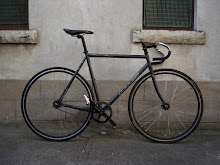
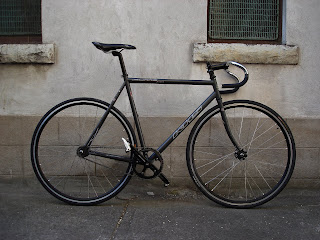
Special bikes are used to ride on the velodrome, known as track bikes. These bikes have only 1 gear ratio which is 'fixed' to the wheel, this does not allow the rider to coast. These bikes also lack brakes and water bottle cages. Though riding on the track may be a bit scary at first it is actually a thrilling experience shared by cyclists various ages and levels. Beginners must go through training sessions to understand how to ride a track bike and how to ride on the track safely. The drills are as much fun as they are necessary to enjoy the track.
Aside from the thrill from speed, track cycling offers many benefits for cyclists. Track bikes are great for improving pedal performance since the bike forces riders to constantly pedal, often at a high cadence. This helps smooth out pedaling technique and really kick the nasty habit of coasting. Workouts can also be done efficiently without having to stop or slow down for red lights or canceled due to bad weather.
I had the opportunity to visit the velodrome yesterday for the second time. During my first visit, a few friends and I went through the Track 1 Session, learning the basics of how to ride the bike on the velodrome. Yesterday, we did Track 2 working on faster riding, riding in a group as well as some really fun drills. Track cycling is definitely something every cyclist should try, especially for those who want to improve their fitness level. the FCV is open year round and is perfect for winter training.
For more information visit www.forestcityvelodrome.ca
Winter here in Toronto with its snow, slush and bitter cold force many cyclists into hibernation from as early as November until as late as March. For many, this means losing that toned butt and superb stamina they developed over the summer, but it doesn't have to end there. Imagine being able to keep cycling during the winter in an environment free of potholes, red lights, head winds and angry motorists. The Forest City Velodrome provides one of the most unique cycling experience as riders can ride on an indoor cycling track capable of reaching speeds in excess of 60km/hr. Located 2-hours outside of Toronto in London it has been open for cyclists since 2005 and is one of only 4 existing in Canada. it is maintained by the Forest City Velodrome Association, a not-for-profit organization of passionate volunteers.
Special bikes are used to ride on the velodrome, known as track bikes. These bikes have only 1 gear ratio which is 'fixed' to the wheel, this does not allow the rider to coast. These bikes also lack brakes and water bottle cages. Though riding on the track may be a bit scary at first it is actually a thrilling experience shared by cyclists various ages and levels. Beginners must go through training sessions to understand how to ride a track bike and how to ride on the track safely. The drills are as much fun as they are necessary to enjoy the track.
For more information visit www.forestcityvelodrome.ca
Wednesday, June 17, 2009
A safe place to park.
Toronto's ring and post line many city streets, providing thousands of parking spots for bikes. The simple design allows for various lock up methods and can accommodate various lock sizes and styles. The added ring also help prevent bikes from being tipped over easily compared to locking it up to a regular sign or lamp post. They are simple, compact and flawed. Shortly after the implementation of these rings it was discovered that they can be broken into using leverage force from something as simple as a 2x4 plank of wood:
Thieves can easily pop off the ring, remove the bike and take it home (with or without the ring attached, depending on how the bike was locked) and cut the lock at their own leisure. The city has attempted to solve this issue by adding an additional ring to reinforce the first, however, the process has been very slow leaving hundreds or vulnerable ring & posts being used. In addition, the added thickness of the ring makes locking up a bit difficult for people with shorter U-locks such as the Kryptonite Evolution which are well used due to their reliability and compact size.
It would be great to see the city look at other types of posts for bikes, in fact there are a few different examples used in Toronto. The example below was taken at an apartment building just south of St. Clair W / Bathurst. The large ring has the potential to lock up 2-4 bicycles depending on arrangement. It's simple but effective.

Over the next little bit I'll be posting other examples of public/private outdoor parking infrastructure used in Toronto. What's great about having different kinds is that it helps deter theft, having different designs means thieves would have to think up ways to break into each one instead of plan for just 1 design. In addition, different designs can be used based on available space and layout of the sidewalk. Lastly, they can add to the aesthetics of the streetscape when done right.
It would be great to see the city look at other types of posts for bikes, in fact there are a few different examples used in Toronto. The example below was taken at an apartment building just south of St. Clair W / Bathurst. The large ring has the potential to lock up 2-4 bicycles depending on arrangement. It's simple but effective.
Over the next little bit I'll be posting other examples of public/private outdoor parking infrastructure used in Toronto. What's great about having different kinds is that it helps deter theft, having different designs means thieves would have to think up ways to break into each one instead of plan for just 1 design. In addition, different designs can be used based on available space and layout of the sidewalk. Lastly, they can add to the aesthetics of the streetscape when done right.
Wednesday, June 10, 2009
A Bike Lane Done Right
Bike lanes are a great way to promote cycling in cities, they provide a buffer for cyclists and make riding safer. That is, if cars don't park in them, they are clear of debris and they actually lead anywhere. Another problem with bike lanes is that they create vehicular conflict/confusion when it comes to turning; cyclists are stuck in the right hand lane which can be a problem when they want to make a left and can be caught between a right turning vehicle and the curb at intersections. Because of the segregated nature of bicycle lanes, many drivers and cyclists, are left wondering how to negotiate with these issues. This can result in cyclists riding on the pedestrian cross-walk in order to make left turns, or cyclists attempting to pass drivers on the right hand side of a vehicle which is attempting to make a right turn (which can lead to the devastating right-hook). Cyclists such as John Forester suggest that bike lanes should be eliminated and that cyclists should act more like drivers in cars should in order to promote safer cyclist/driver relations on the road. Though this can be possible it's something we are far from accomplishing and something I'll rant on sometime later.
In Toronto, there are a few examples of bike lanes that actually take these conflicts into consideration. Often, you will see bike lanes suddenly disappear at intersections which can create confusion and danger. The photo below was taken at Old Fort York & Bathurst where a bike lane splits into 2 lanes, one for right turning bicycles and another for left turning. Both are well supported with indicator arrows and a buffer on the left turning bike lane also adds to the safety. Of course, this may not necessarily work at every intersection as such a scheme requires a lot of lane-width and must also take into consideration traffic speeds as cyclists must exit the bike lane, merge into traffic and then merge into the left turning lane. Still, this is a nice example of the city trying to look out for cyclists and drivers.
Sunday, June 7, 2009
Ride for Heart
I had the opportunity to bike in the Becel Ride for Heart. The weather was a little chilly with spitting rain, but despite that it was a great ride. The volunteers and staff were enthusiastic and very helpful and I managed to pickup some good speed, averaging 30kph in the 50km course. Despite all this, there were some set backs.
The one thing that really bothered me (and I'm sure some others as well) was the poor riding etiquette from the less experienced riders. I may not be an expert in group riding but I know that it's only common sense to look where you are going and avoid getting in the way of faster riders. I had way too many close calls with cyclists who decided to swerve across 2 or 3 whole car lanes without even so much as glancing, signalling or calling their movement. There was one particular rider who insisted on getting in my way and ignored any attempt at trying to warn him of my passing him. Sudden erratic movement, suddenly stopping, riding 4 or more abreast, not signalling, passing awfully close and littering were some of the bad habits I encountered. There was one crash that could have easily been avoided had riders followed the rules; part of the route involved riding on an off ramp from one road to the expressway, it was a tight one-laner with a barricade. A cyclist decided to try and cut corners, effectively cutting in the path of several others forcing a pile up. I loved the ride and I'll do it next year, I just have to ride with even more vigilence than if I were riding in heavy traffic.
On a related note, CP24 ran a poll asking viewers if major roadways should be closed for fundraising events. Strangely, well over 60% of viewers think roads should only be closed for repairs. Actually, it isn't strange, it's a perfect example of car-culture affecting our society. It has become obvious that for many people the ability to drive their car from point A to B as fast as possible has taken priority over things such as fundraisers to help support life-saving research. If that's the case it looks like cultural, social, ethnic, historical or any fun event for that matter such as festivals, block parties, parades and stuff of the sort are bad too. There goes Salsa at St. Clair, Caribana, the Pride Parade, and a whole slew of others! So is the Santa Claus parade bad too? What about the Toronto Marathon?
The one thing that really bothered me (and I'm sure some others as well) was the poor riding etiquette from the less experienced riders. I may not be an expert in group riding but I know that it's only common sense to look where you are going and avoid getting in the way of faster riders. I had way too many close calls with cyclists who decided to swerve across 2 or 3 whole car lanes without even so much as glancing, signalling or calling their movement. There was one particular rider who insisted on getting in my way and ignored any attempt at trying to warn him of my passing him. Sudden erratic movement, suddenly stopping, riding 4 or more abreast, not signalling, passing awfully close and littering were some of the bad habits I encountered. There was one crash that could have easily been avoided had riders followed the rules; part of the route involved riding on an off ramp from one road to the expressway, it was a tight one-laner with a barricade. A cyclist decided to try and cut corners, effectively cutting in the path of several others forcing a pile up. I loved the ride and I'll do it next year, I just have to ride with even more vigilence than if I were riding in heavy traffic.
On a related note, CP24 ran a poll asking viewers if major roadways should be closed for fundraising events. Strangely, well over 60% of viewers think roads should only be closed for repairs. Actually, it isn't strange, it's a perfect example of car-culture affecting our society. It has become obvious that for many people the ability to drive their car from point A to B as fast as possible has taken priority over things such as fundraisers to help support life-saving research. If that's the case it looks like cultural, social, ethnic, historical or any fun event for that matter such as festivals, block parties, parades and stuff of the sort are bad too. There goes Salsa at St. Clair, Caribana, the Pride Parade, and a whole slew of others! So is the Santa Claus parade bad too? What about the Toronto Marathon?
Subscribe to:
Posts (Atom)